
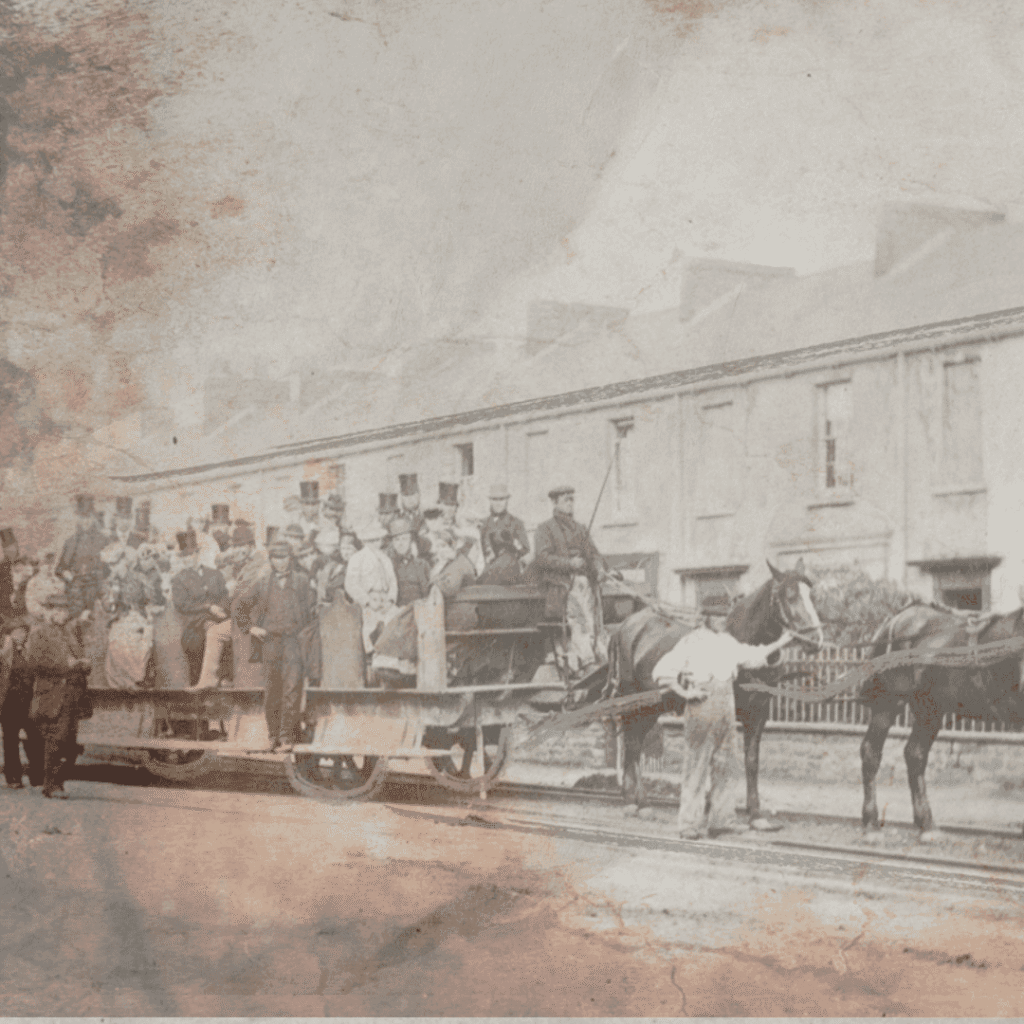
On this day in 1807, the world’s first fare-paying passenger railway began operating in Wales, inspired partly by children who would hop rides on horse-drawn freight wagons along the route.
It was eventually known as the Mumbles Railway, which became the world’s longest continuously operating railway line.
Laid in 1804 mainly for industry—specifically, transporting limestone from Oystermouth (also called Mumbles) and coal from Clyne to Swansea’s piers for shipping—passengers were initially an afterthought.
The first passenger vehicle was a horse-drawn 12-seat carriage that covered approximately five miles between Swansea and Oystermouth, giving the line its original name, Oystermouth Railway.
It lacked a formal ticket office or platform—just a waiting spot. As access to seaside villages improved, their popularity increased; by 1823, a one-horse carriage carrying 16 passengers operated twice daily. However, the line’s success was short-lived: a parallel road opened, reducing demand, and passenger services stopped, although the line was sometimes used for coal transport.
Passenger service resumed in 1855, sparking ongoing innovation. Steam power arrived in 1877, followed by experiments with sail (wind), diesel, petrol, and electric power—six different sources in total, more than any other railway.
By the 1900s, it was known as Mumbles Railway. After electrification in 1928, double-decker trams were introduced, and by the 1940s, millions of passengers used it annually.
Post-World War II fuel rationing ended, and with increased competition from buses and cars, the railway’s outdated infrastructure—requiring around £350,000 in upgrades—was no longer justified given the declining demand. Service was discontinued on 5 January 1960.
The previous night, thousands of Swansea residents, dressed in funeral attire, gathered with an empty coffin, singing dirges to say farewell to their beloved railway.